The Aula Magna is a place that connects me deeply with my youth and my cultural heritage. As a Venezuelan being born in Caracas, this hall has been part of my life since childhood. The hall itself is a spectacle, there is an almost magical combination of elements that makes it truly special. I am aware that the Aula Magna was built before the Jet Age era, however, as many other Mid Century Modern buildings, it has enough elements that were the inspiration and foundation of future design concepts that were part of that era.
I will begin by sharing a bit of its history to understand why it has been, and continues to be, an astonishing place… This hall is part of the Universidad Central de Venezuela (UCV), which was declared a UNESCO World Heritage Site on November 30, 2000. When the construction of the Central University of Venezuela was first proposed, the government sent delegates to various international universities to gather ideas and understand everything involved in such an ambitious project. Among the university models they visited, they chose the campus model, inspired by the Socratic proposal of integrating the arts and sports into academic studies.
The Master
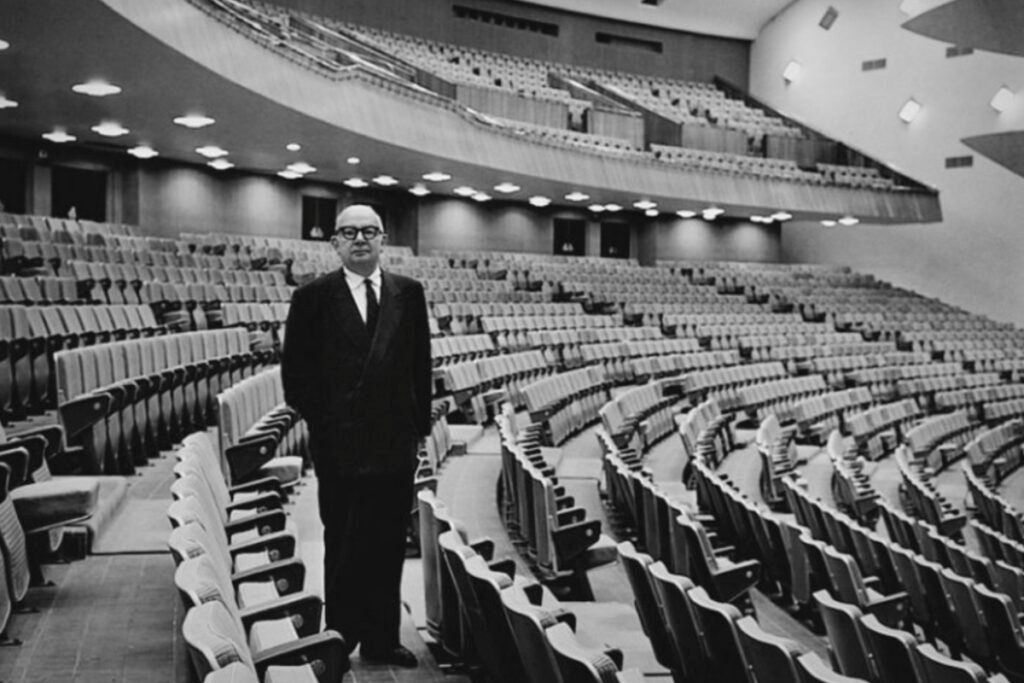
Carlos Raúl Villanueva inside the Aula Magna
The chief architect was Carlos Raúl Villanueva, one of the most important figures in Venezuela’s contemporary history. Villanueva was born in the United Kingdom in 1900; his mother was French and his father Venezuelan. He studied architecture at the École Nationale Supérieure des Beaux-Arts in Paris in 1922, and later studied urban planning at the Université de Paris in 1937.
When Villanueva settled in Venezuela, he initially worked on residential urban development projects in neighbourhoods such as El Silencio, El 23 de Enero, El Paraíso, and Cerro Piloto. In addition to designing the UCV, he also received various commissions that included museums, schools, and even the Venezuelan Pavilion at Expo 67 in Montreal, Canada.
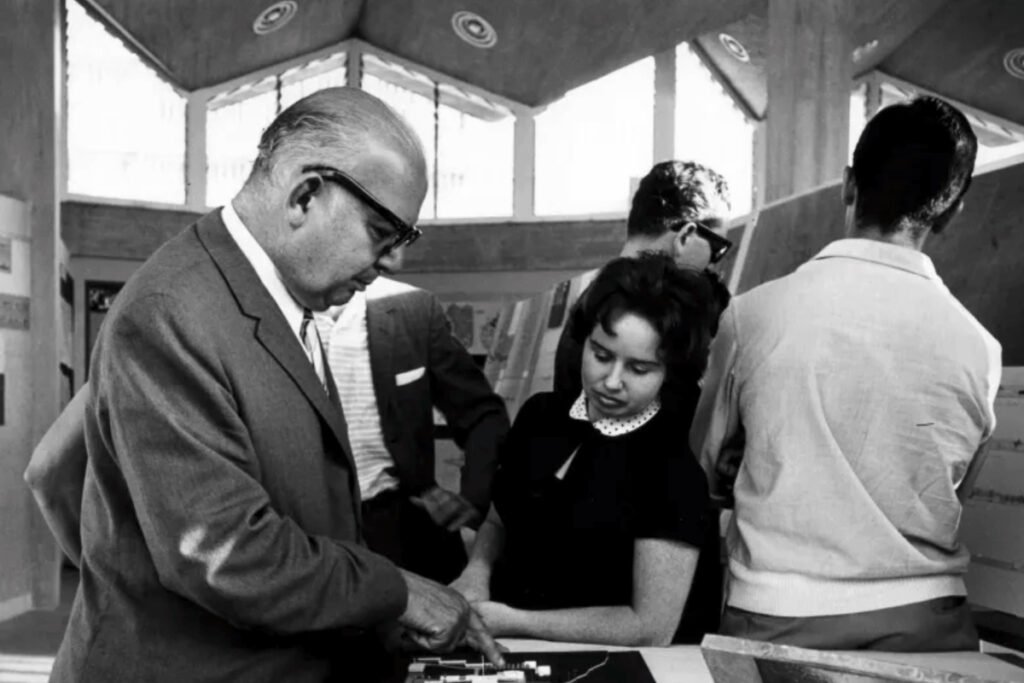
After the completion of the UCV, Villanueva collaborated with the creation of the School of Architecture and Urbanism. Then he became a History of Architecture and Urbanism professor, role that gave him the title of The Maestro.
Villanueva teaching at the UCV
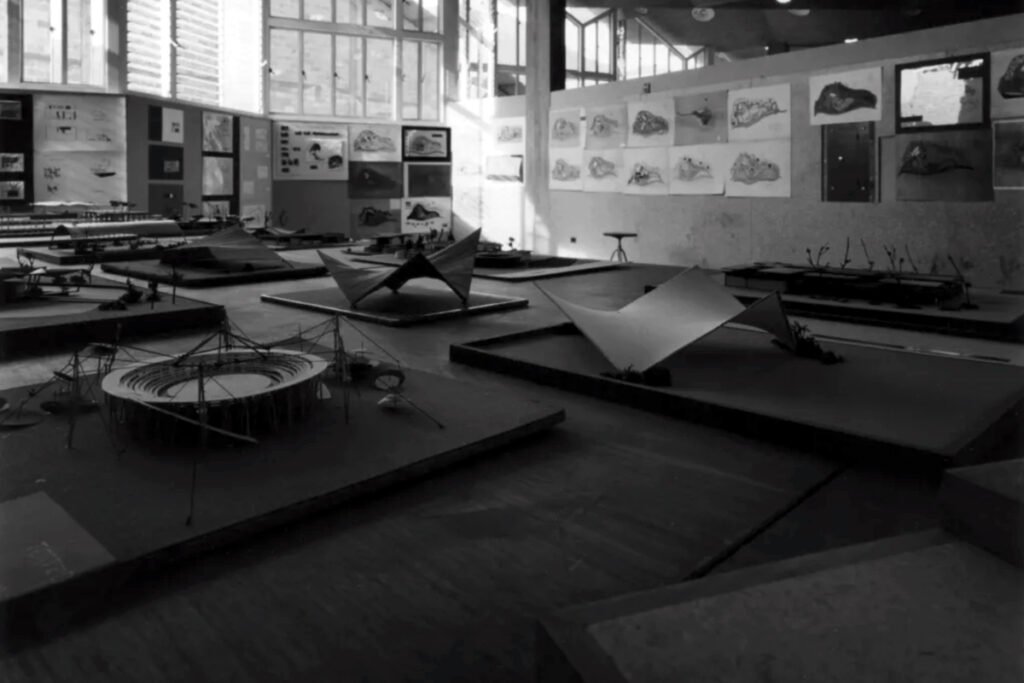
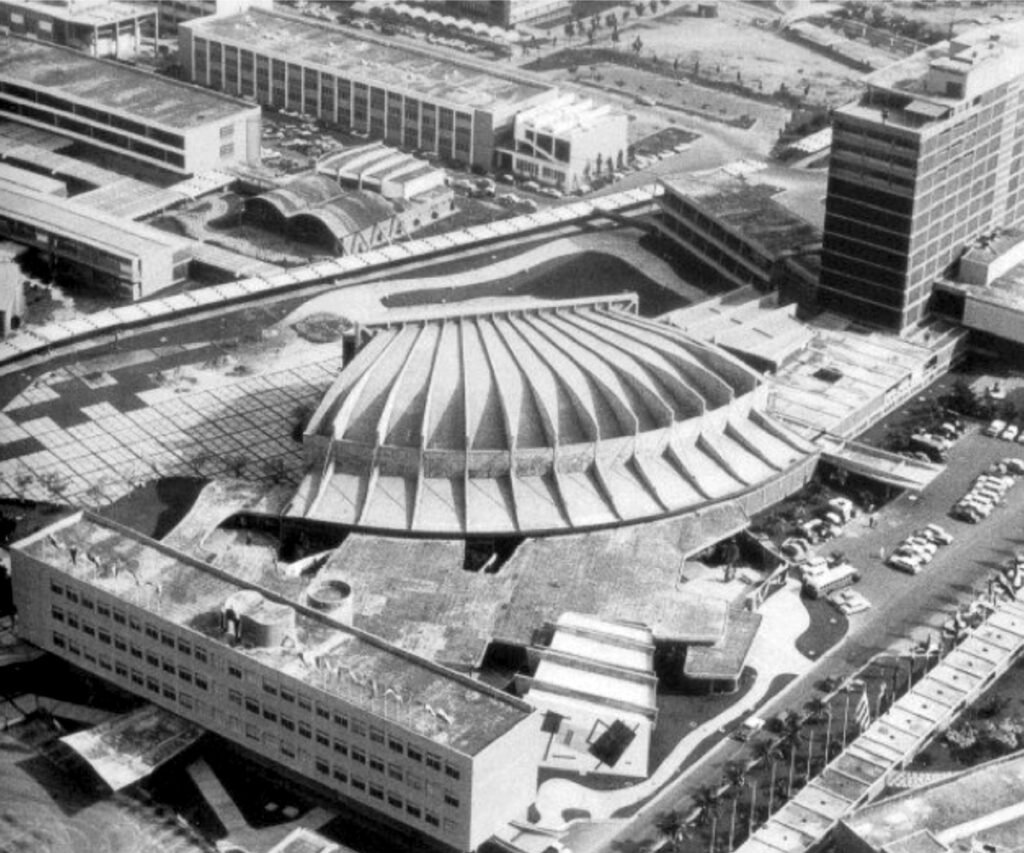
Architecture and Urbanism School at the UCV
The Building
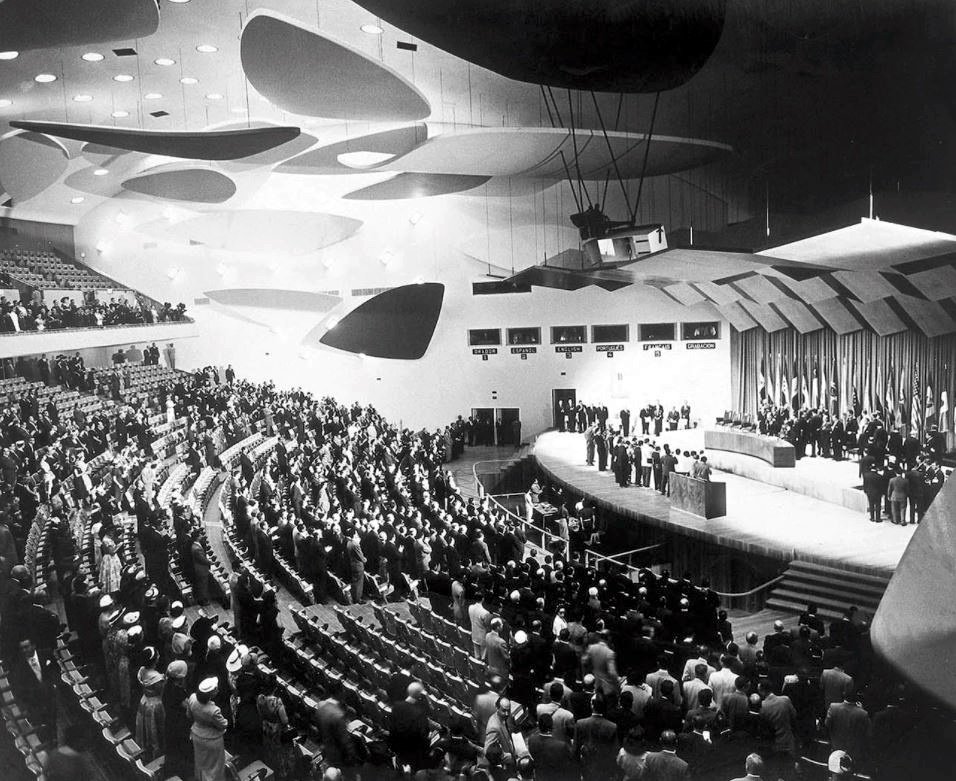
10th Ibero-American Conference of Heads of State and Government – March 2nd 1954
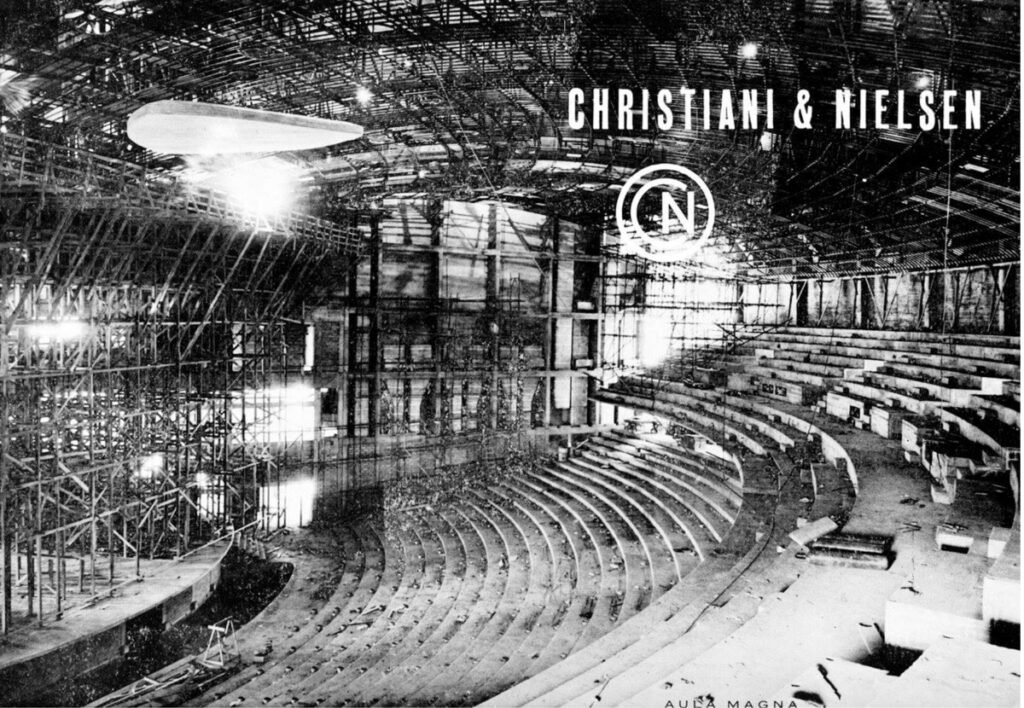
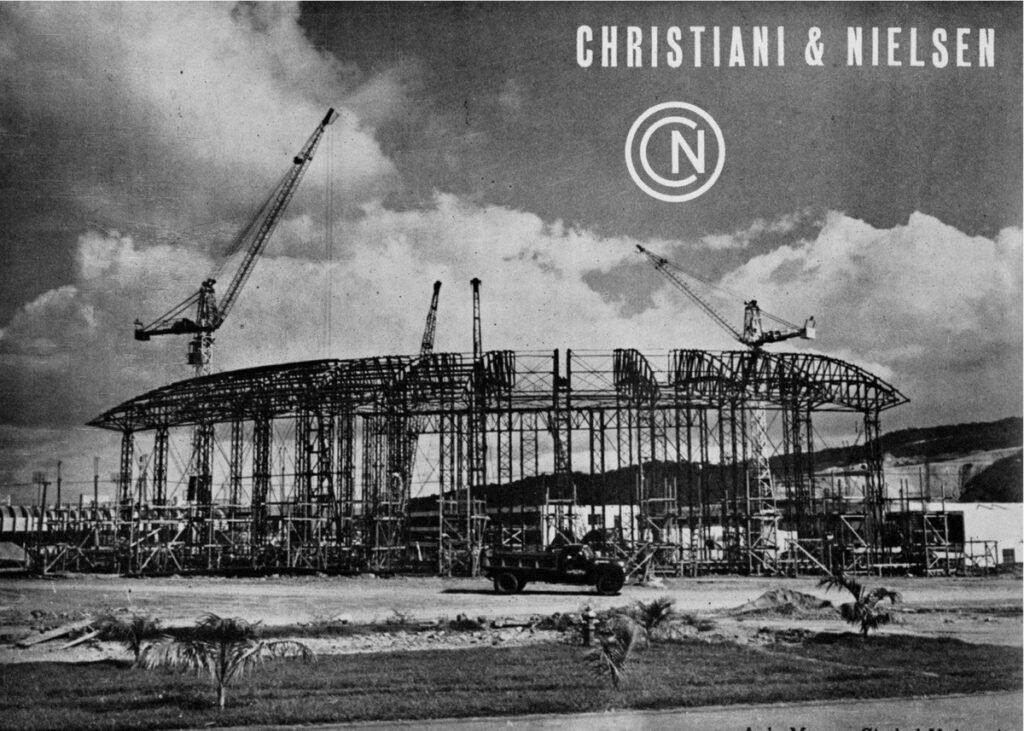
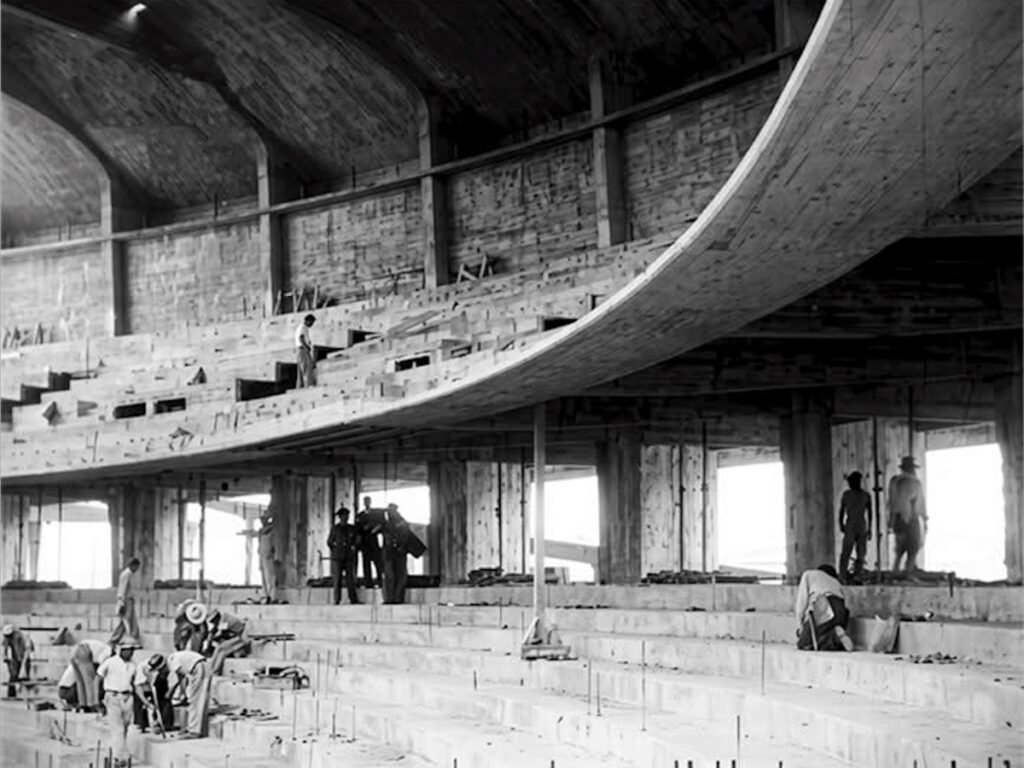
The construction of the Aula Magna was completed in just four months. This was record time considering the complexity of the building’s design and all the technical elements inside it, which required an extremely advanced level of precision. The company appointed for the construction was the Danish firm Christiani & Nielsen. The hall was officially inaugurated on March 2, 1954, with the opening of the 10th Ibero-American Conference of Heads of State and Government.
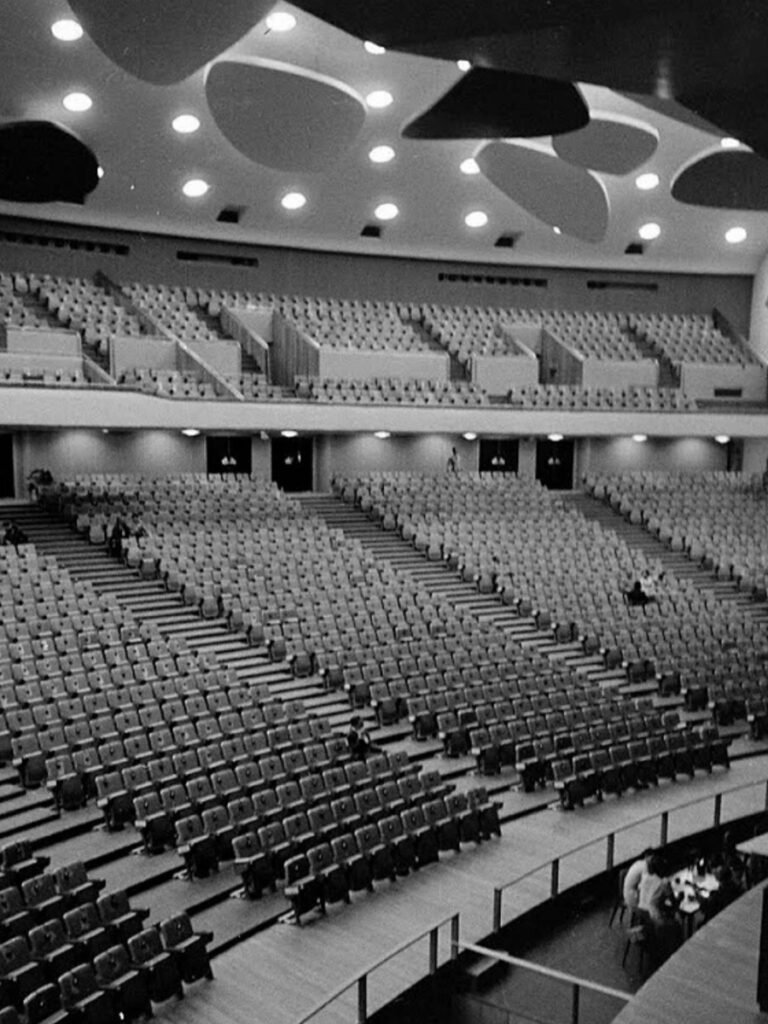
The Aula Magna can accommodate 2,696 spectators (1,722 in the orchestra section, 961 in the balconies, and 13 in the Honor Box). Some seats can be removed to adapt the space depending on the event. Ithas seven access doors for the orchestra section and five for the balcony areas through two systems of ramps.
Original concrete ceiling
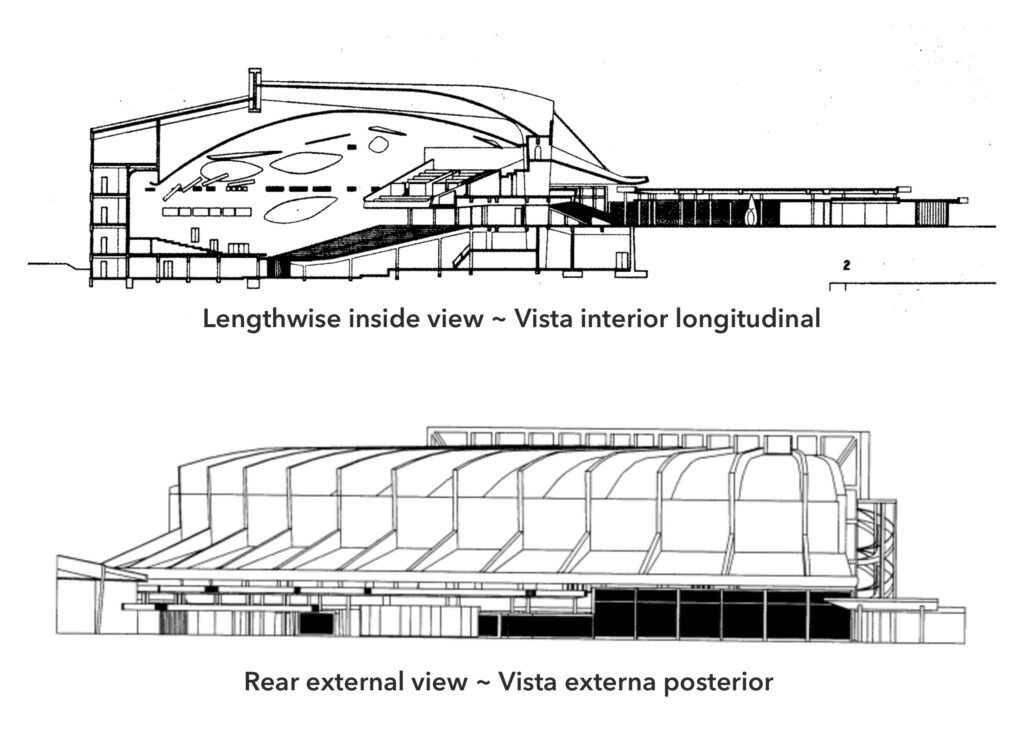
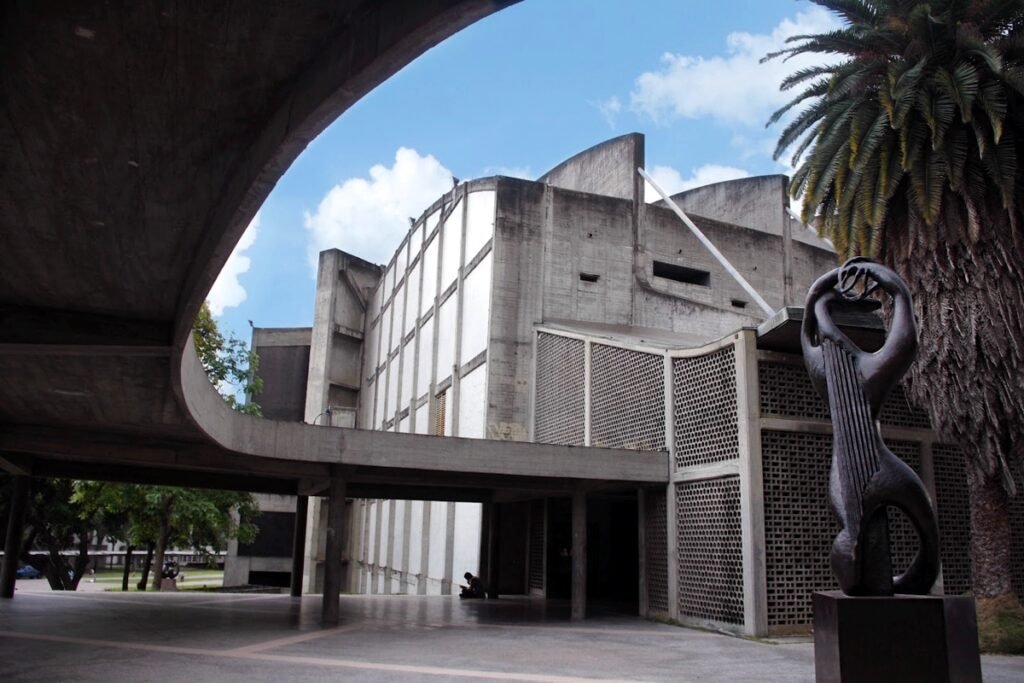
The building’s structure consists of 691 reinforced concrete piles measuring 18 meters (59 ft) in length, with exposed concrete finishes composed of a portal-like Vierendeel beam structure. This 100-ton metal framework rests on small fan-shaped columns, from which the false suspended plaster ceiling hangs. The shell-shaped poured concrete roof is 8 cm (3.14 inches) thick, and the supports used to distribute its weight were designed to prevent vibration. Echoes were controlled in the rear section of the hall using wooden details and plaster coatings.
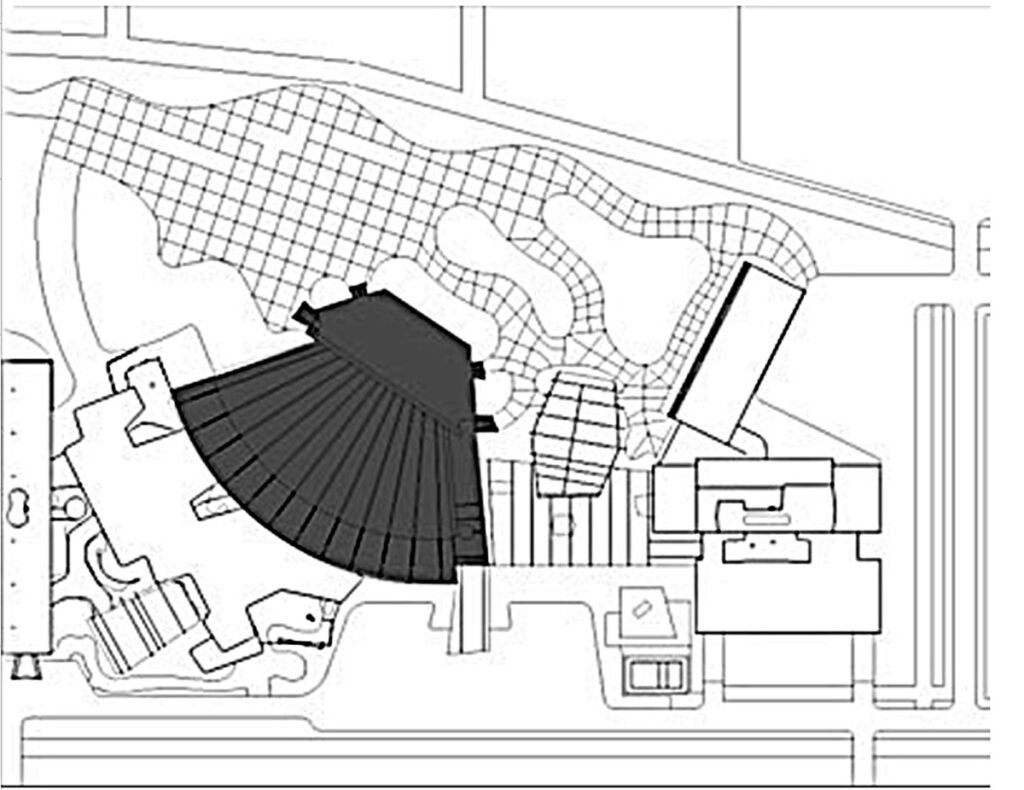
Aula Magna location blueprint
Art and Architecture
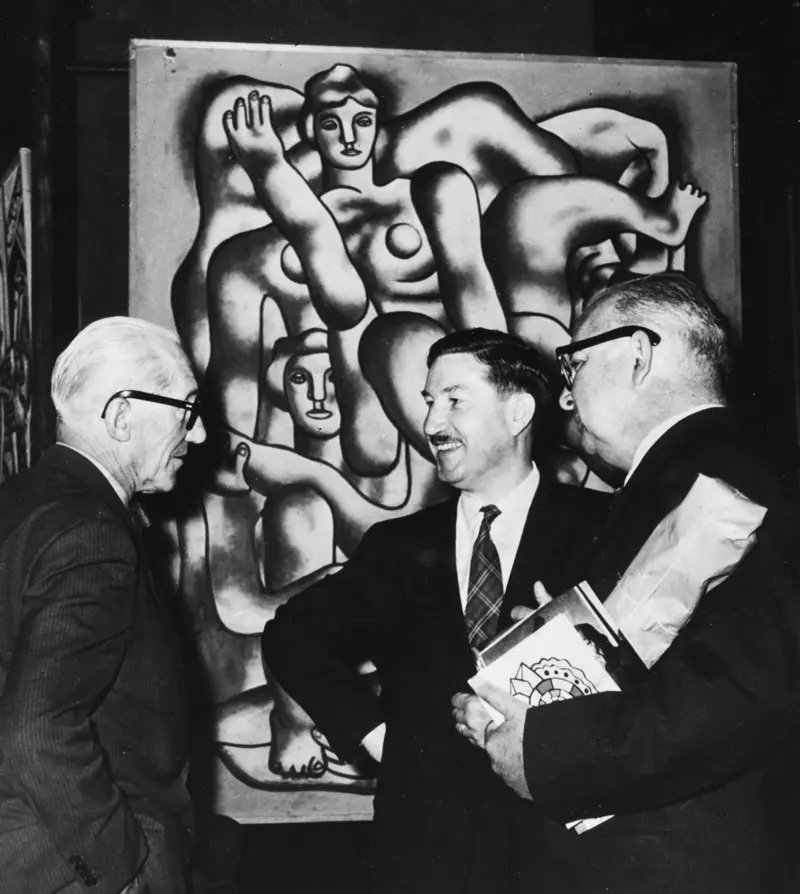
Villanueva and Le Corbusier on the right
During his years of study in France, Villanueva had the opportunity to meet architects and artists from the avant-garde movements of the 1920s, which explains his affinity for the arts and their integration into his projects, especially at the UCV.
With this premise, he incorporated artistic elements into the university in every possible way. In some cases through building façades, and in others through the inclusion of sculptures and murals that energized and complemented the architectural design. This concept became known as the Synthesis of the Arts, where everything converges.
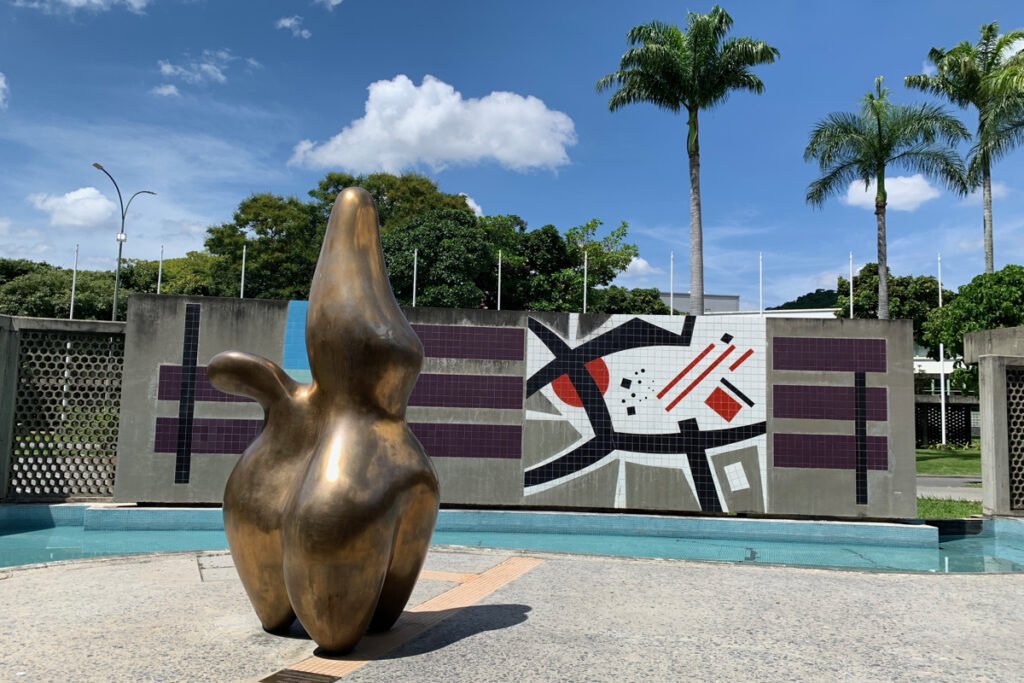
Cloud Sheppard sculpture by Jean Arp and an Untitled mural by Mateo Manaure
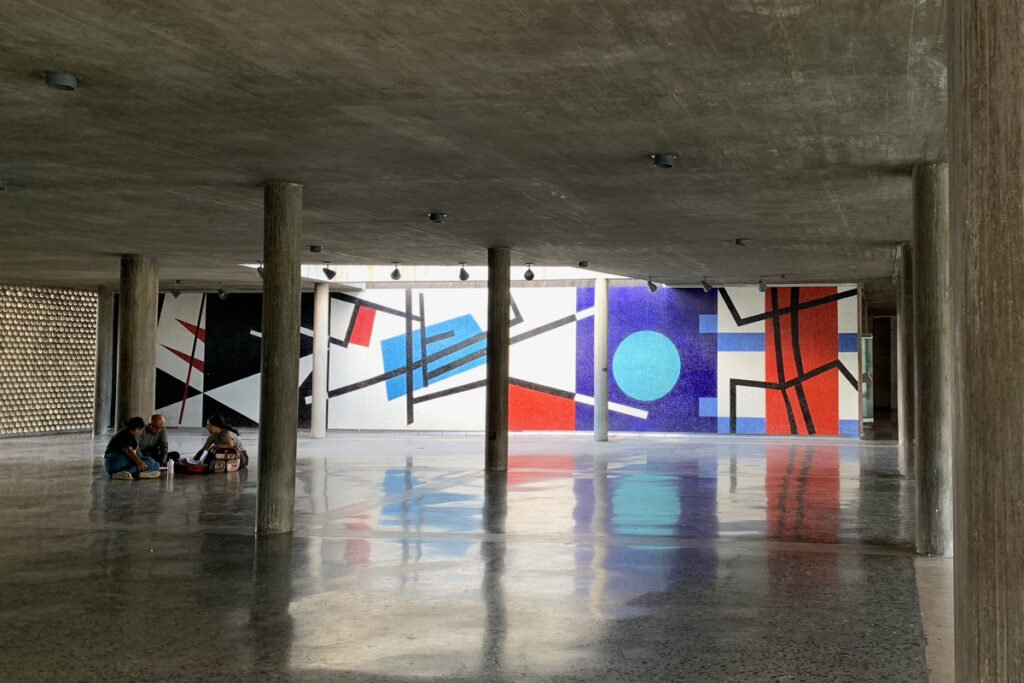
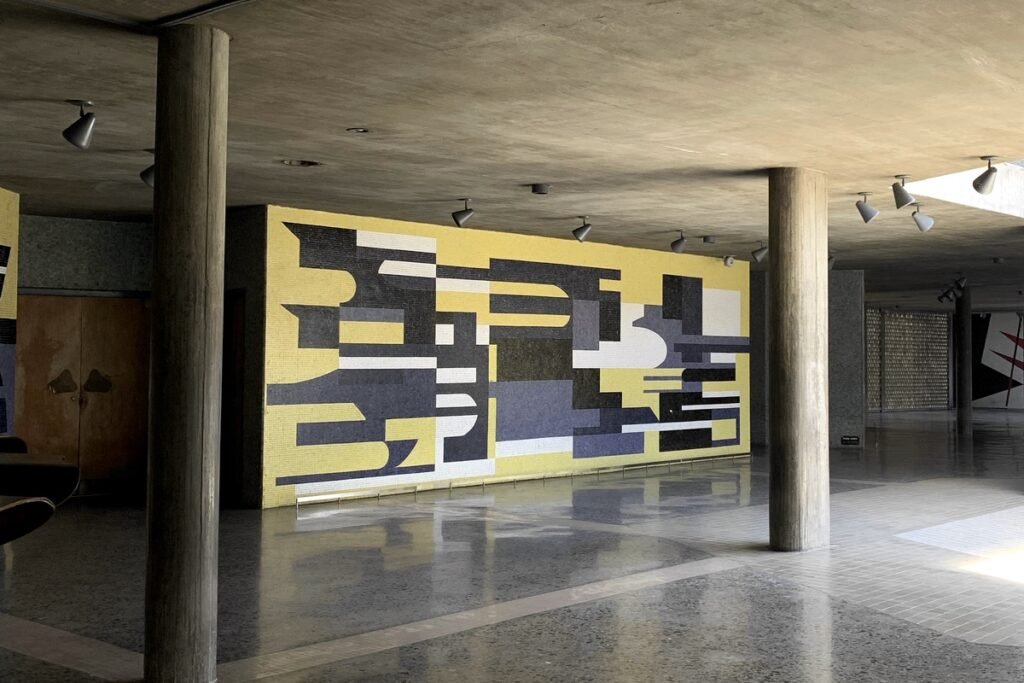
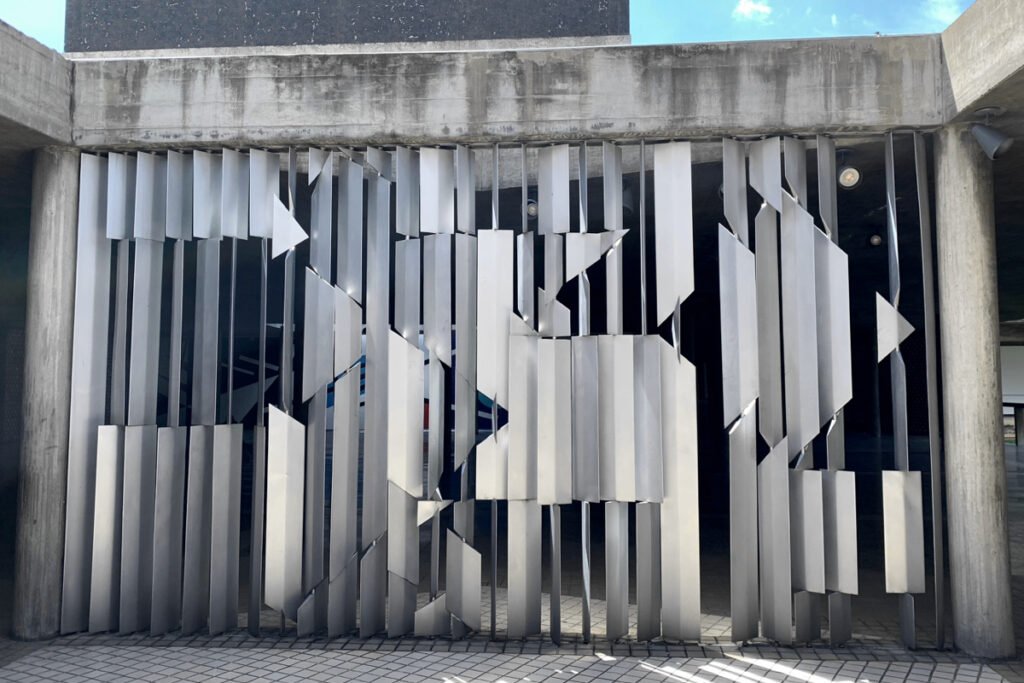
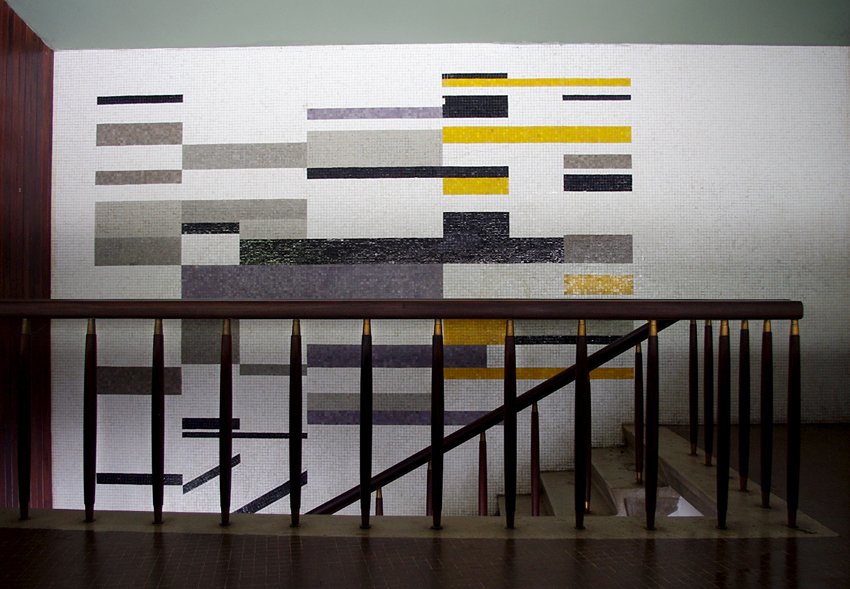
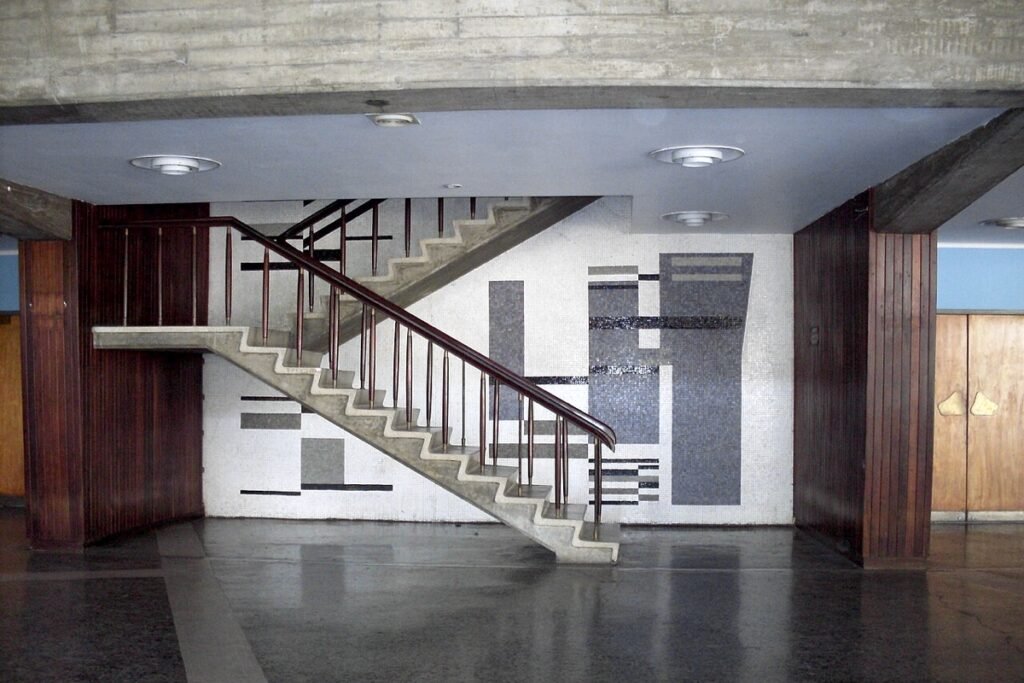
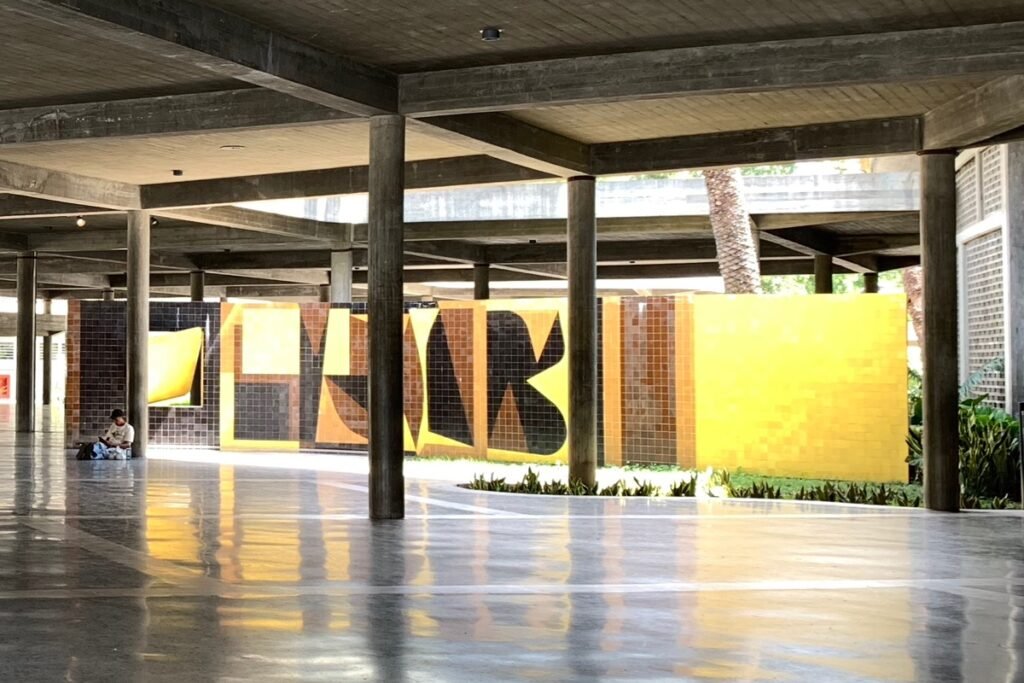
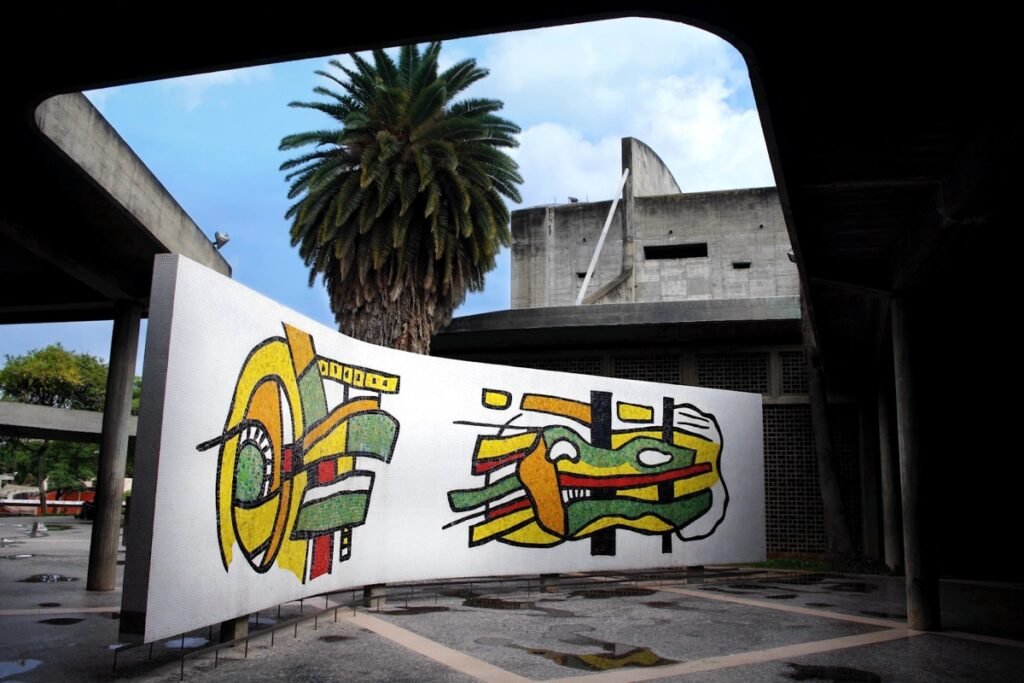
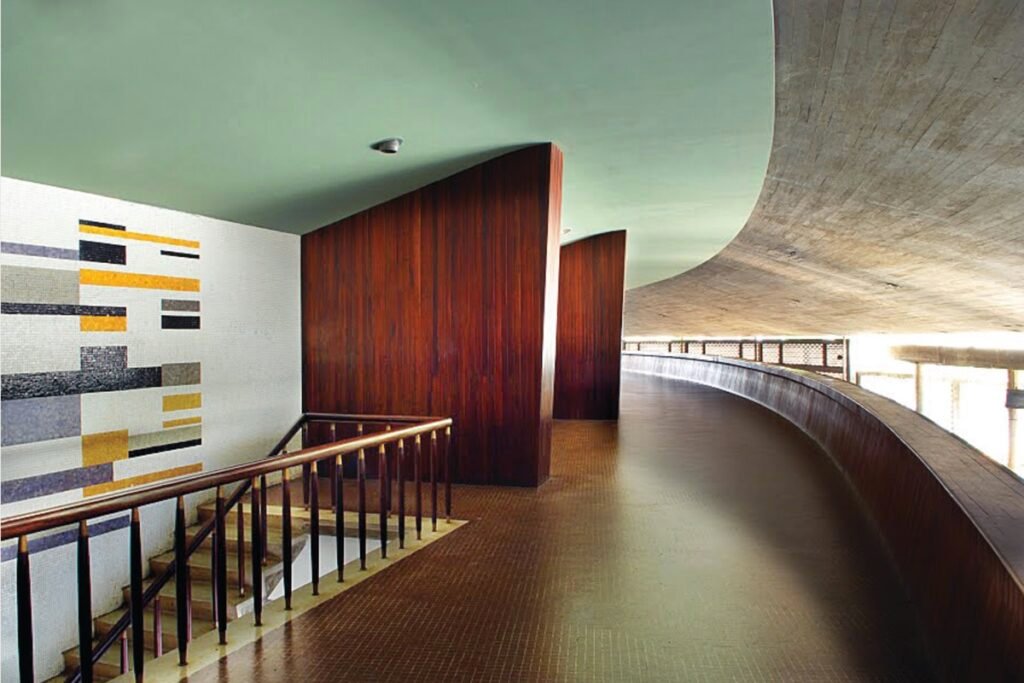
At the Aula Magna the arts were integrated as part of the building itself. The Covered Plaza, area surrounding the hall, was conceived as an open-air museum due to Caracas’ climate conditions. This space houses works by renowned artists, including some sculptures by Jean Arp, Henri Laurens, and Victor Vasarely. It also features a number of murals by artists such as Mateo Manaure, Victor Vasarely, Pascual Navarro, Fernand Léger, and Carlos González Bogen.
Untitled mural by Mateo Manaure
Untitled mural by Pascual Navarro
Positivo – Negativo by Víctor Vasarely
Untitled by Carlos González Bogen – split on two floors
Homenaje a Malevich by Víctor Vasarely
Untitled by Fernand Léger
Amphion by Henri Laurens
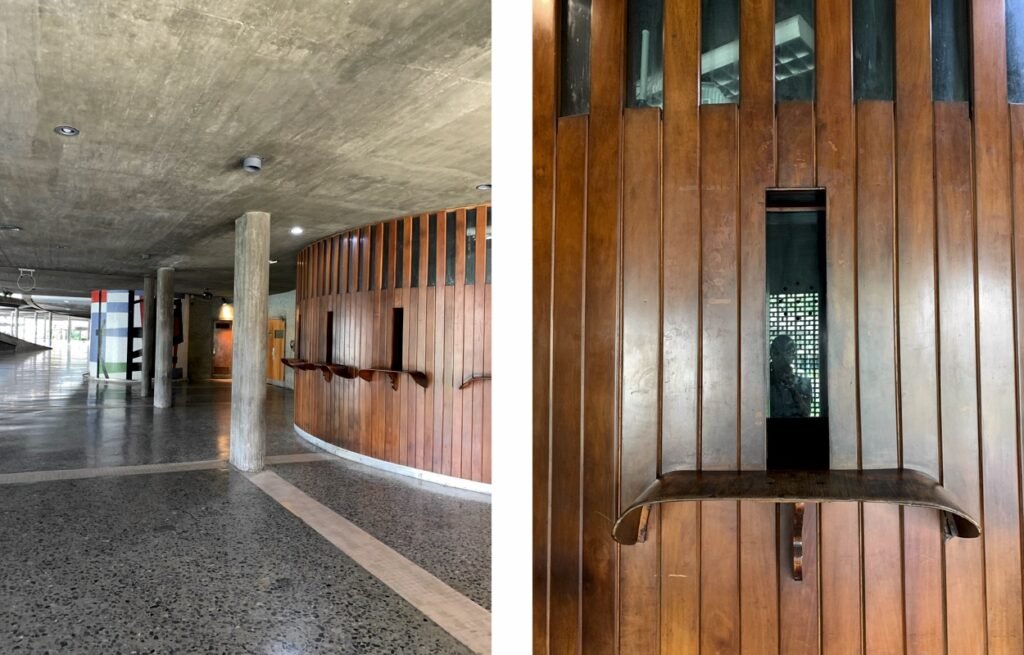
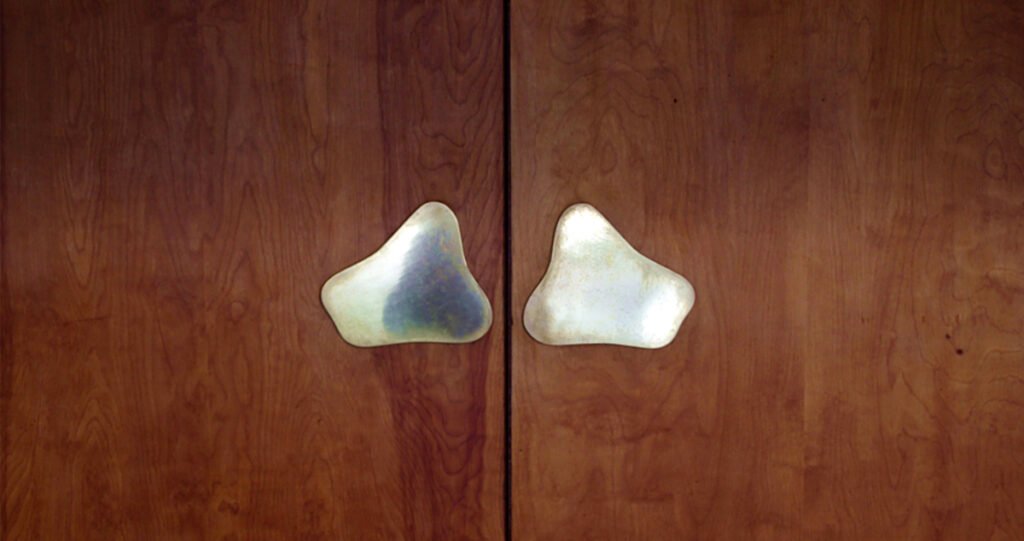
There are other design elements that show how much attention to detail Villanueva gave to this project. The warmth of the wood and the coldness of metal complement the concrete structure on the different areas of the building.
Ticket booths
Upper floor exterior columns
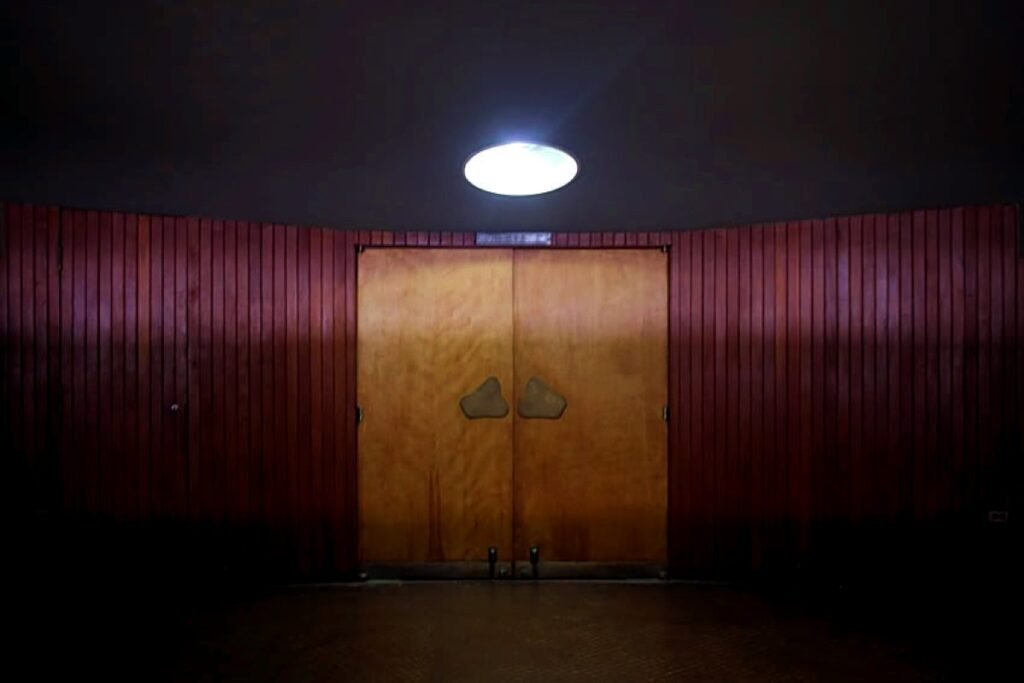
Door handles
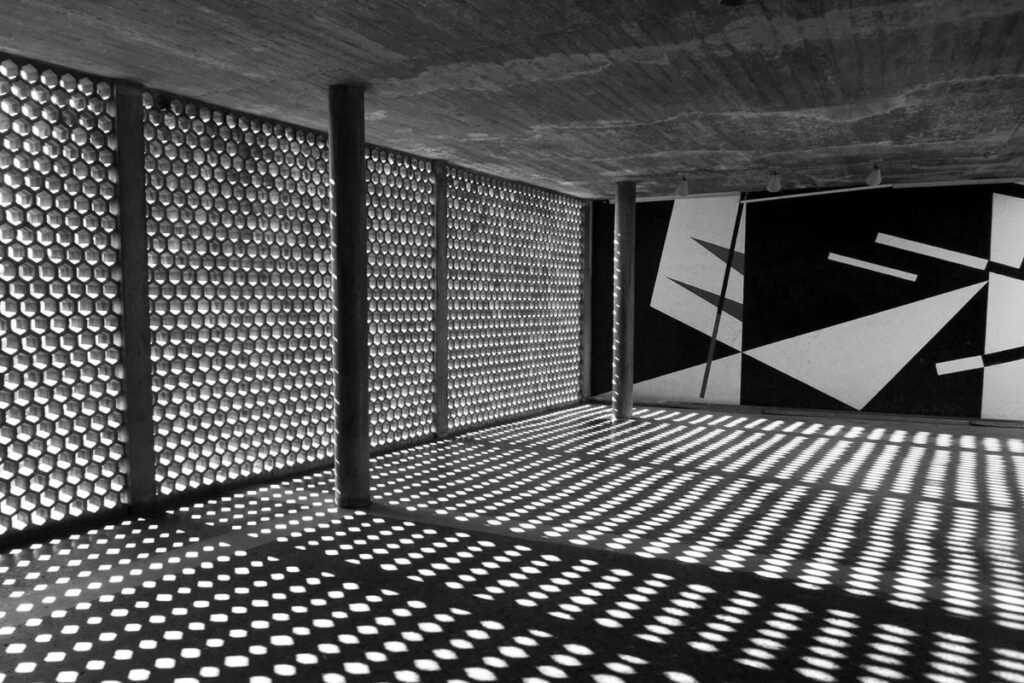
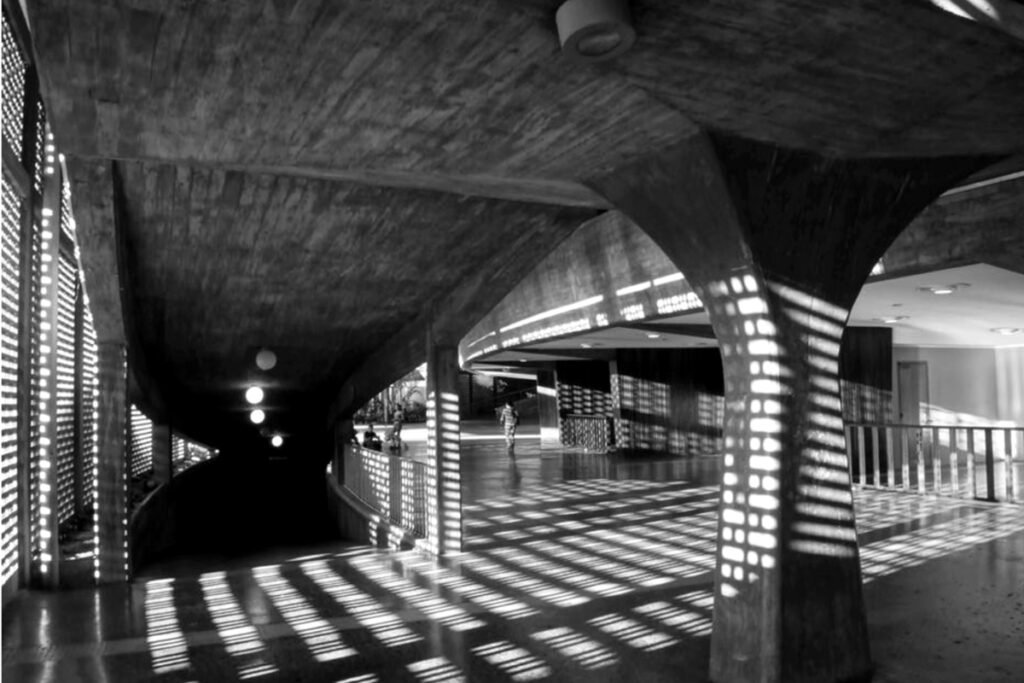
In addition, the hive-shaped perforated brick on the hallways produce a fascinating play of light and shadow depending on the time of day. This not only provides a beautiful visual spectacle, but also help ventilate the spaces during the hottest months of the year.
Art and Acoustics
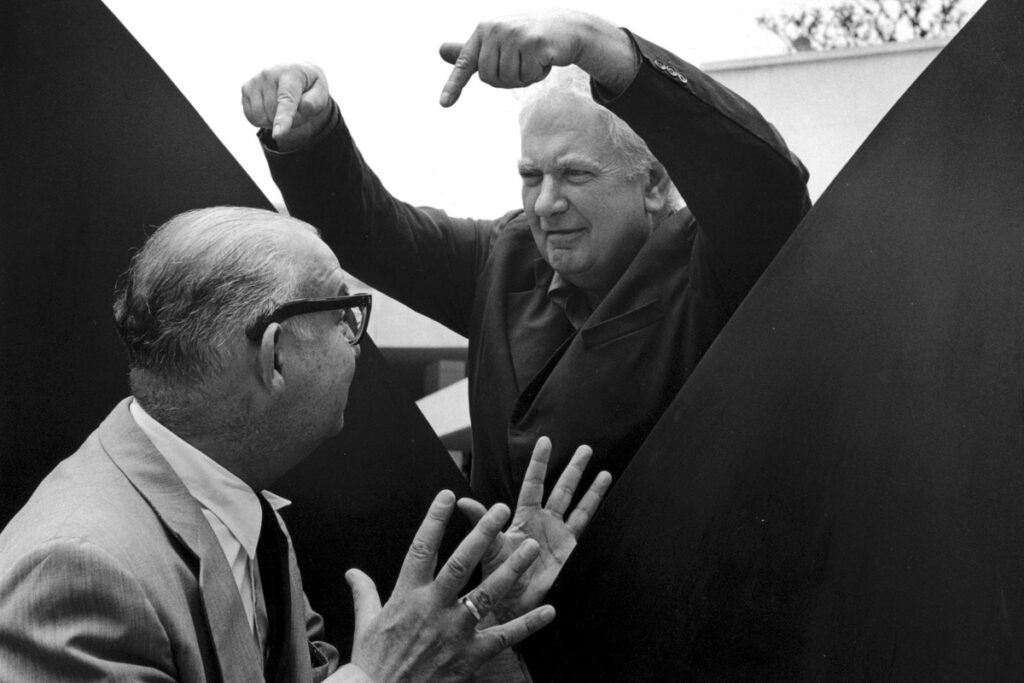
Villanueva and Calder
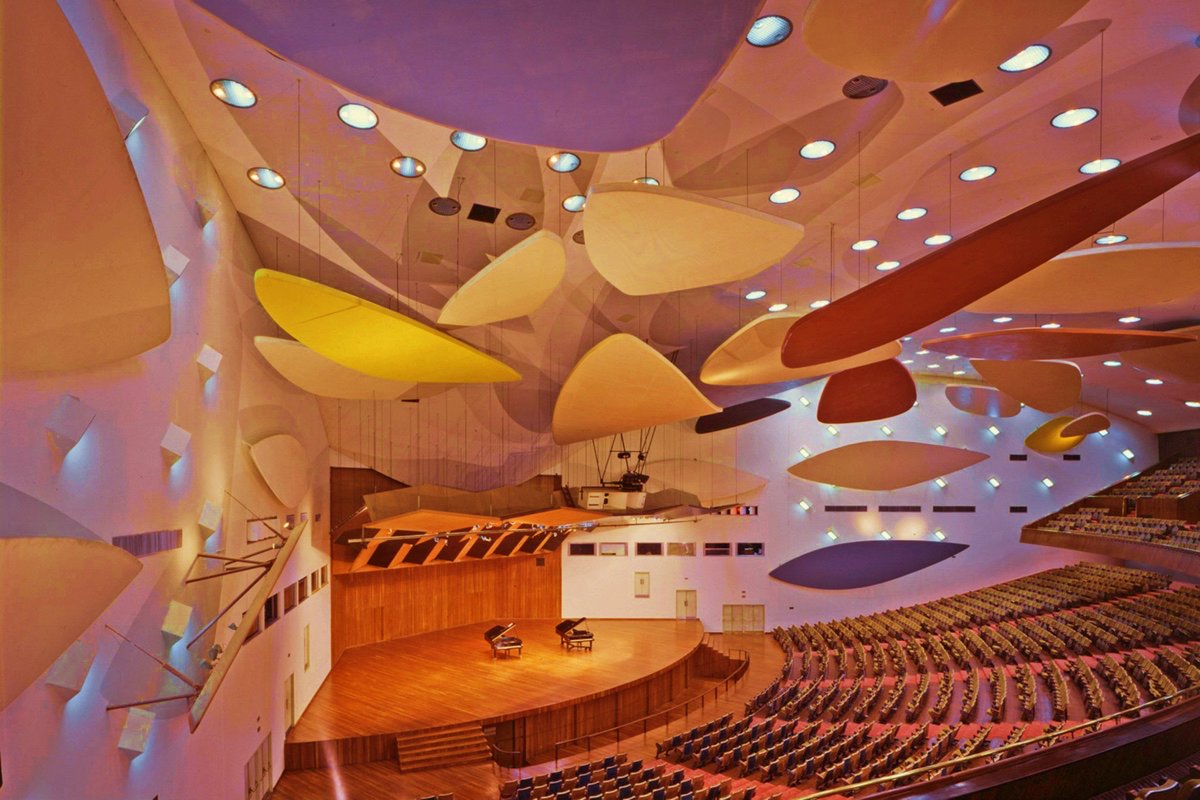
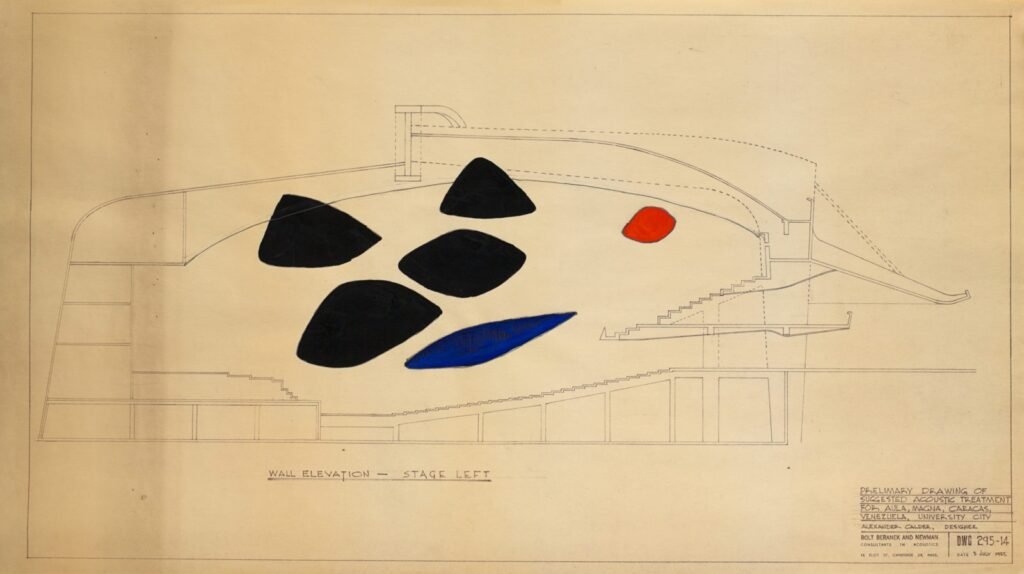
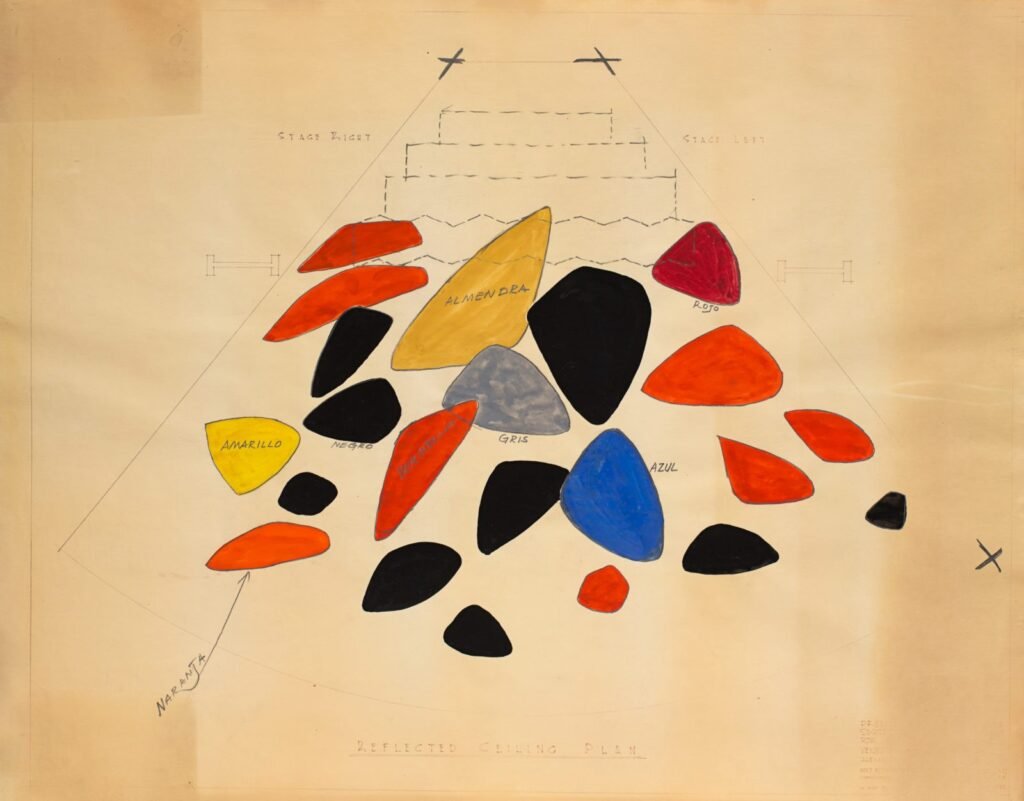
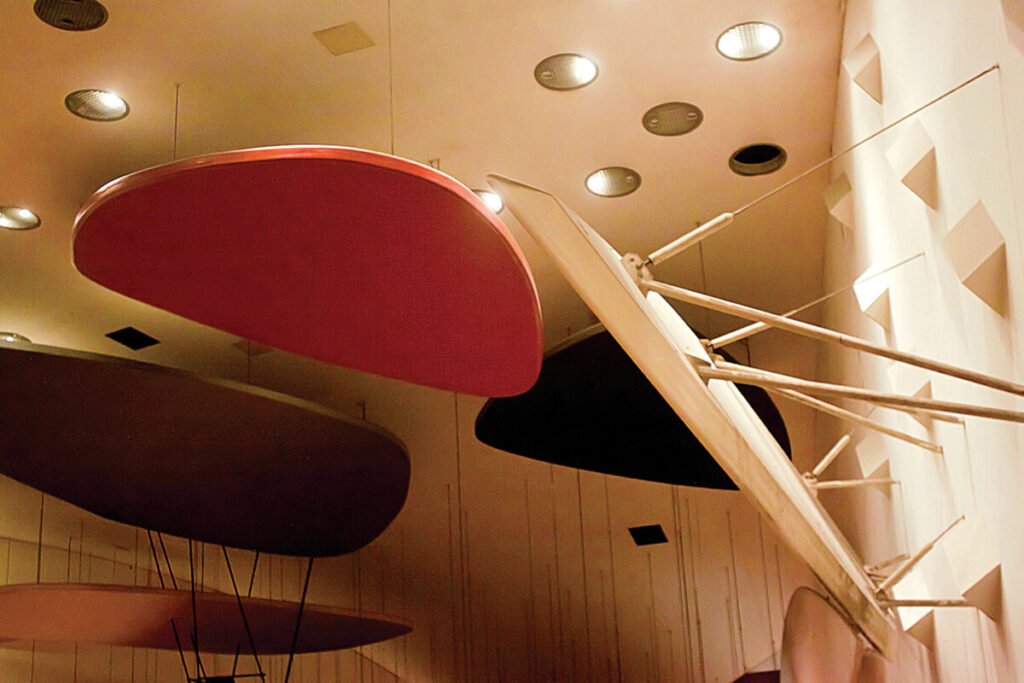
At one point, this place was considered one of the five halls with the best acoustics in the world. However, when it was completed, it suffered from serious acoustic problems and Villanueva did not want to alter the original design of the auditorium. Then, Bolt, Beranek y Newman, company in charge of the acoustics, proposed solving the issue through the installation of suspended panels. Initially, the panels were going to have simple geometric shapes, but Villanueva had a better idea.
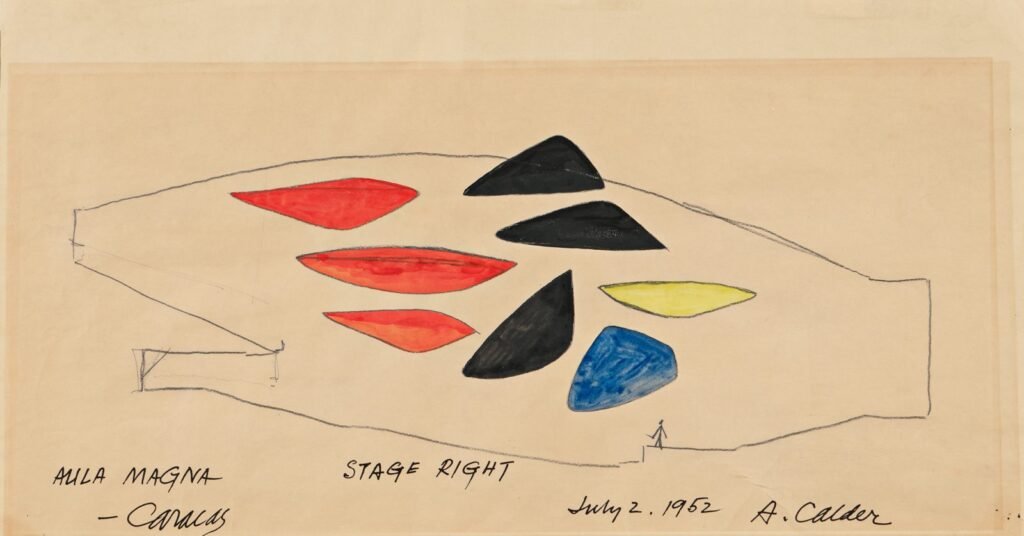
Original sketches by Calder
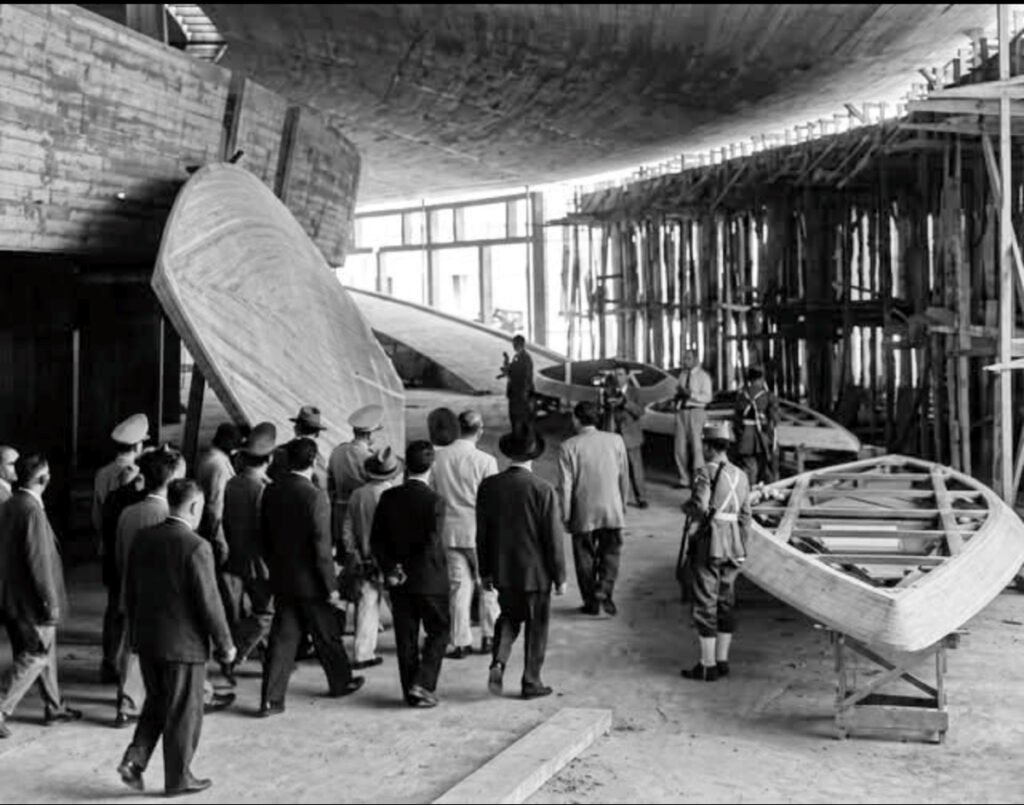
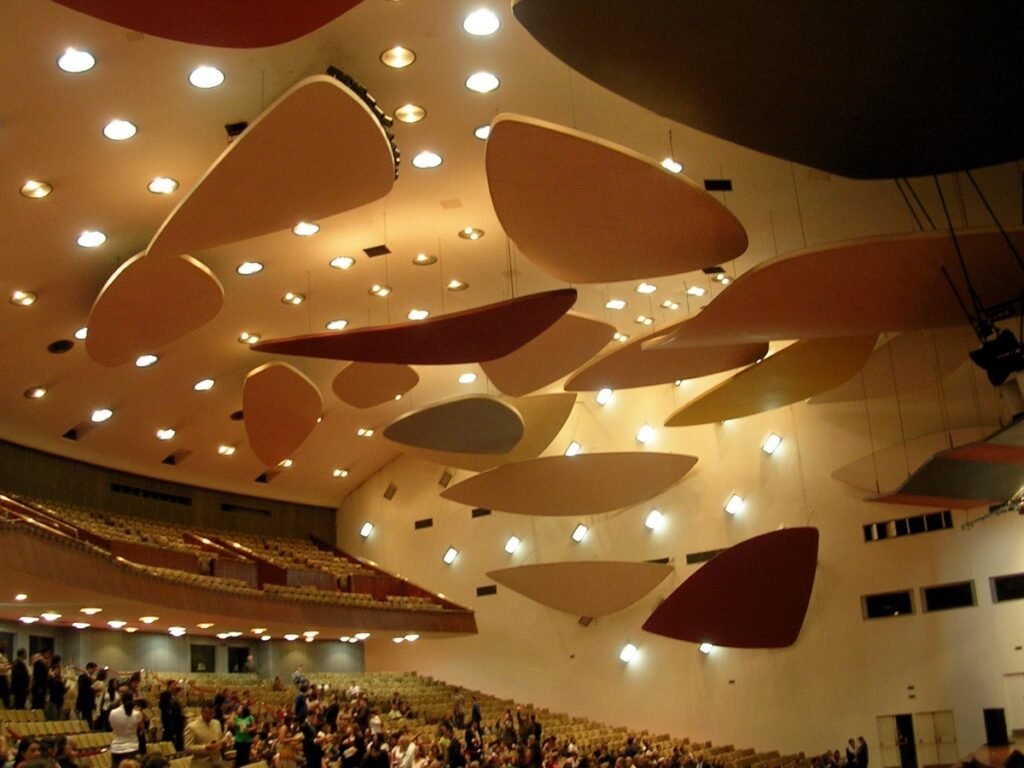
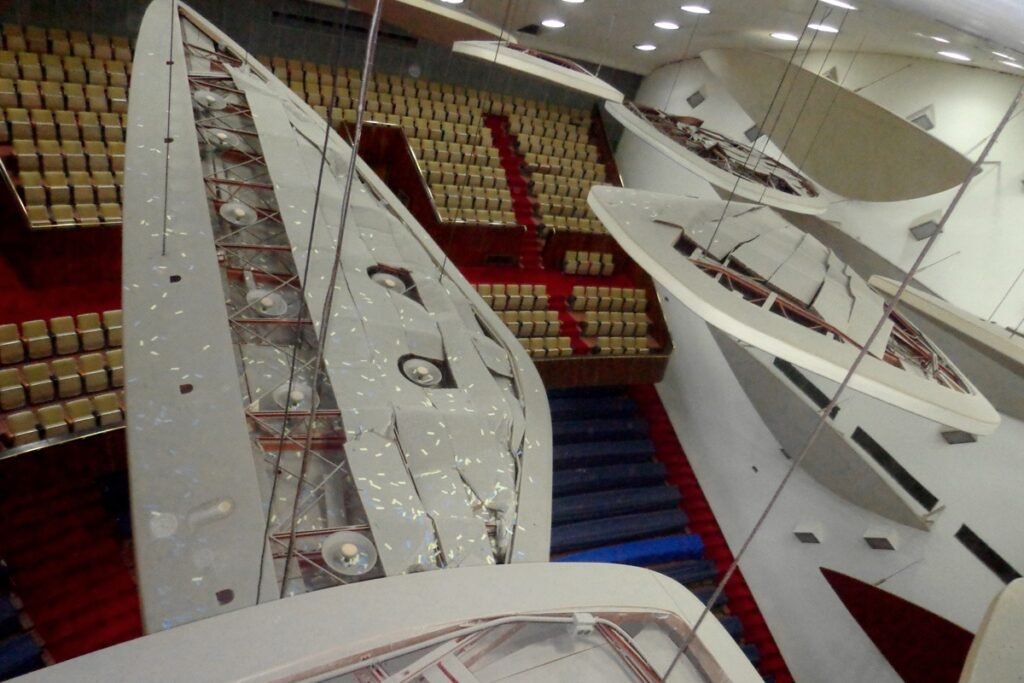
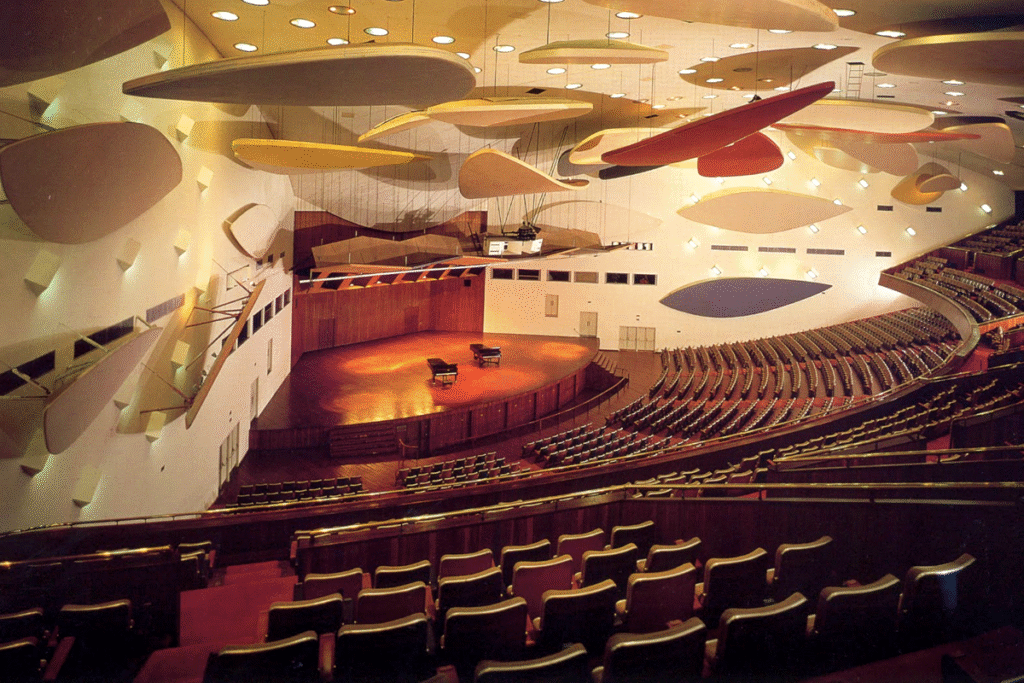
Villanueva had already commissioned Alexander Calder, renowned American artist and personal friend of his, to create a mobile sculpture for the Covered Plaza, location that presented many challenges due to the strong crossed winds. Instead, Villanueva proposed installing Calder’s mobile inside the hall to correct the problem. Calder accepted and took into account the technical specifications of the panels in order to create his work Floating Clouds. This magnificent piece consists of 31 panels in total (22 on the ceiling, 5 on the right-side wall, and 4 on the left-side wall). They were built in the nearby area known as Tierra de Nadie, under the direction of Venezuelan artist Mateo Manaure.
Clouds waiting to be installed
The clouds are built with a steel framework covered with 1.27 cm (half-inch) plywood. The largest has an area of 80 m² (861.1 square feet) and weighs approximately 2.5 tons. Each cloud is suspended by metal cables from the plasterboard ceiling, giving it the necessary tilt and height depending on its size and location. Initially, the clouds could be adjusted to different positions depending on the event’s technical requirements, but eventually a permanent calibration was performed with live orchestra accompaniment to ensure precision.
In addition to Calder’s work, the Aula Magna incorporated other elements to optimize acoustics. The interior side of the doors is made of perforated metal filled with insulating material so that sound does not travel outward or inward.
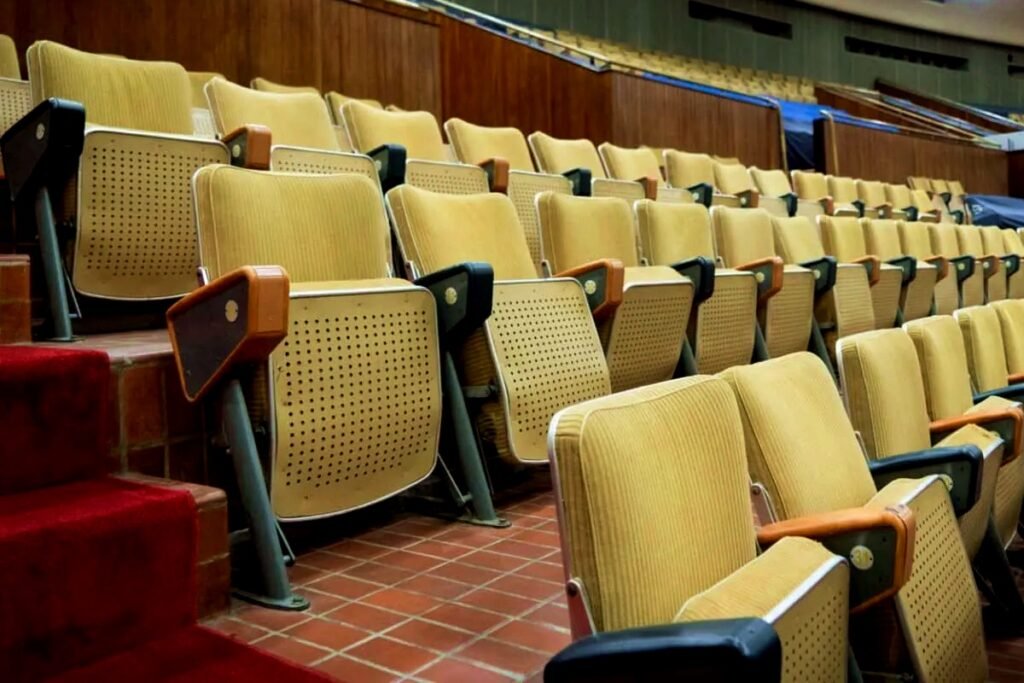
The seats, in turn, have perforations on their underside that are exposed when they are retracted. They are upholstered using a grooved sheep’s wool fabric and they are also filled with balls made of the same material.These two elements combined on the seats counteract the absence of people when the hall is only partially occupied. Also, the carpet layout plays a role in absorbing the rebound of sound waves, preventing undesired feedback noises.
Lighting
The lighting is quite complete and varied. It includes two overhead lighting systems with spotlights, floodlights, projectors, etc. In addition, the clouds have their own lights that project their colours onto the ceiling.
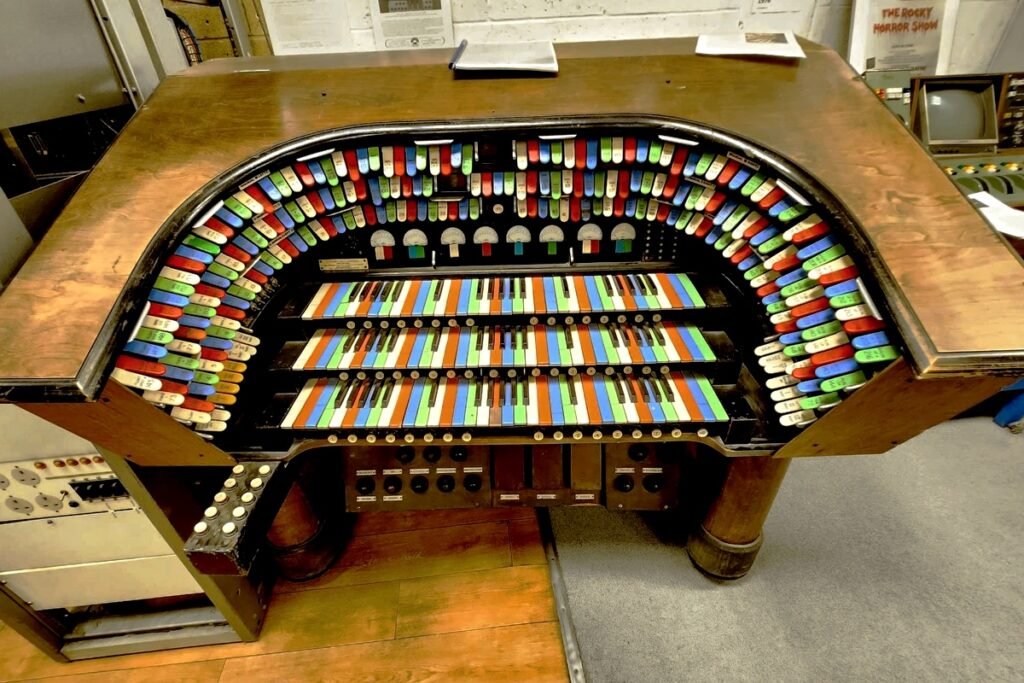
John Compton Organ by The Strand Electric (London)
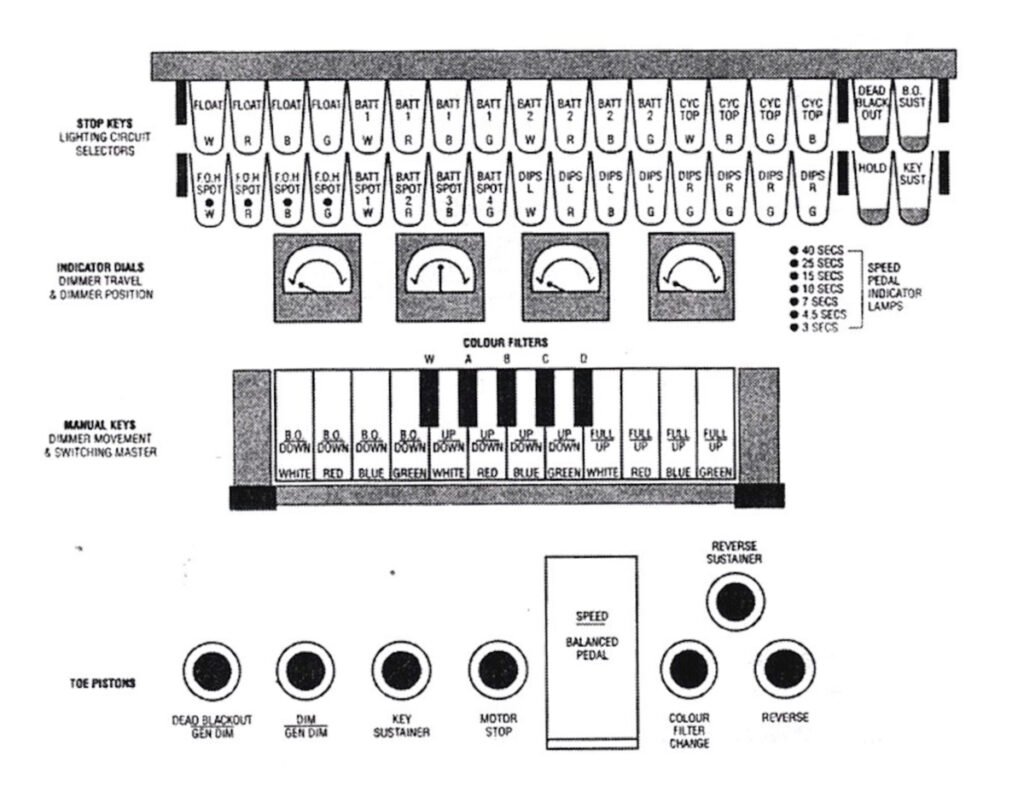
John Compton Organ instructions
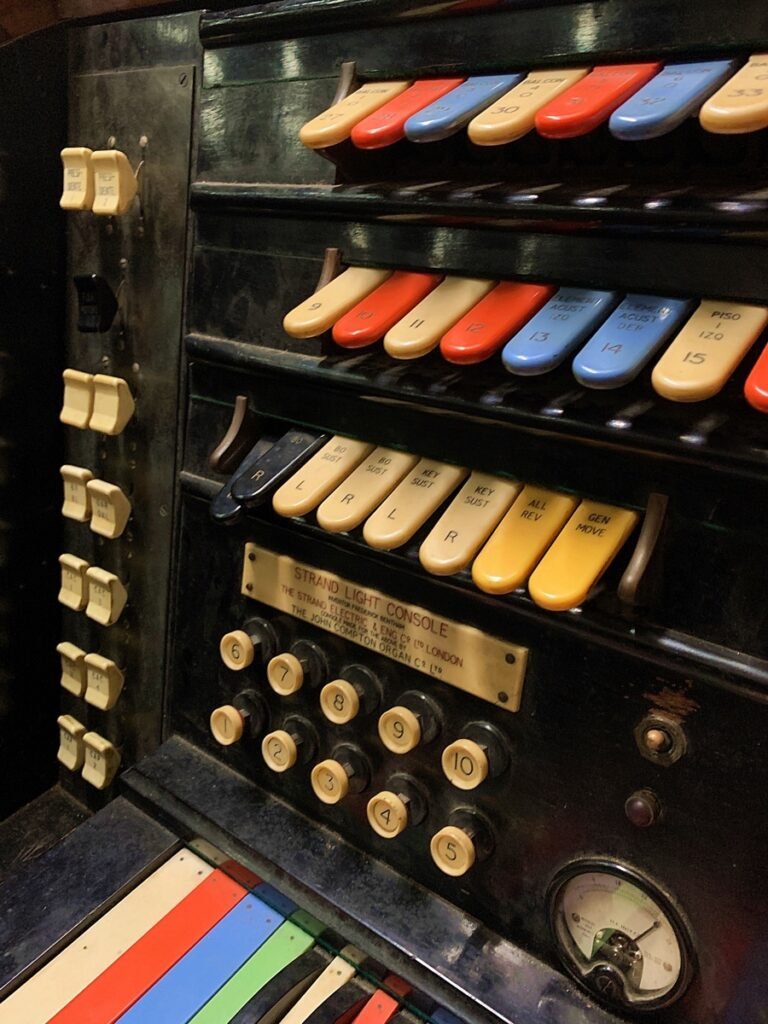
The most technical feature of the lighting system is that it was connected to a Strand Light Console, an organ-like device made by UK John Compton Organ Company in partnership with The Strand Electric. It functioned by pressing different key sequences, including scores, resulting in various lighting effects. As technology was not automatized back then, there was a technician making all the effects happen live. This may not seem remarkable today, but it was highly advanced for the 1950s. Allegedly, the only other organ-console in existence it’s in a London museum.
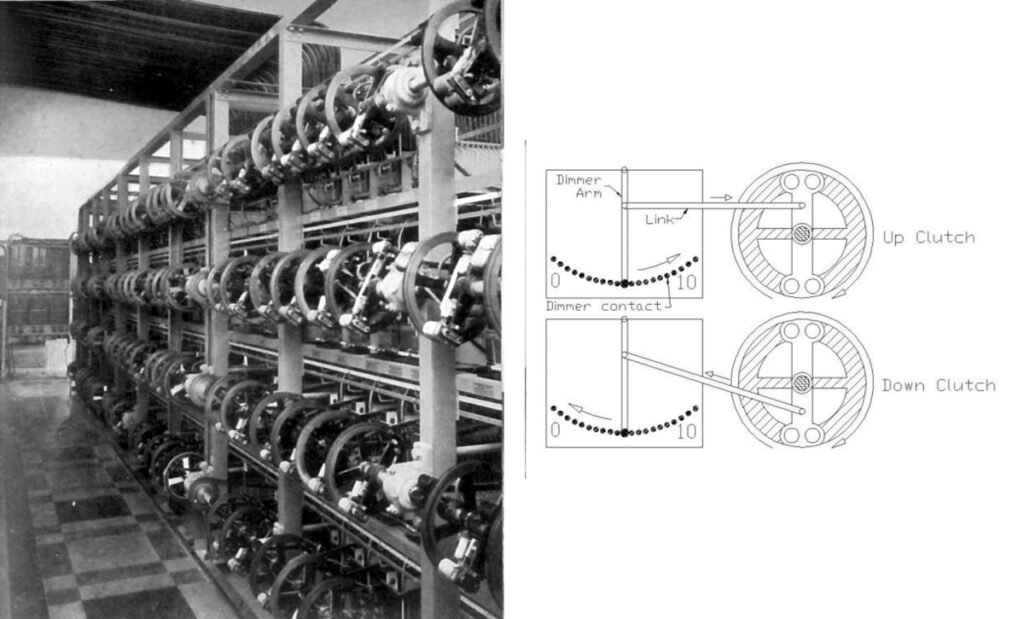
Dimmer bank relays , National Opera House, Lisbon – Circa – 1940
Communication
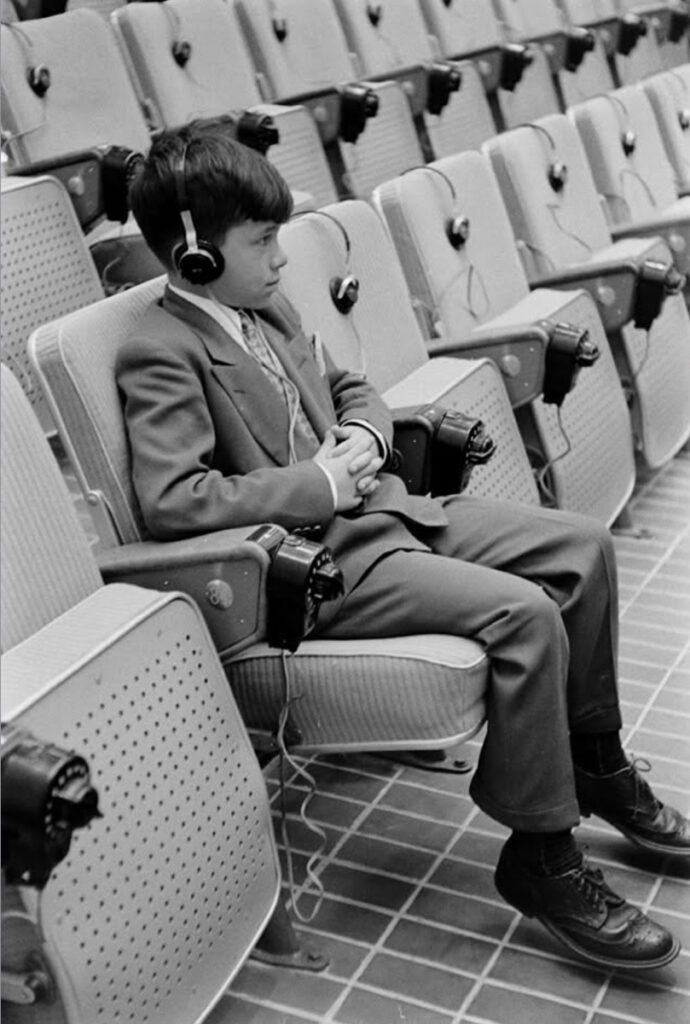
Aula Magna seats setup with headphones
The Aula Magna was conceived as a flexible space where various events such as concerts, conferences, symposiums, etc., could be held. For this reason, a communication equipment that allowed simultaneous translation was installed for events that required it. The audio had different channels depending on the language. The headphone connector was located on the front part of the armrests, similar to those later used on commercial airplanes. Unfortunately, this equipment no longer exists
Restoring the Legacy
As a consequence of defunding of universities and institutions that did not aligned with the ethos of the government that has been in power since 1998, and the extreme financial crisis that the whole country has been part of, resulted in lack of public and private funding. Unfortunately, the Aula Magna went into a severe state of deterioration.
Later, in 2021 the Aula Magna 300 project, was born. The goal was to raise $300,000 to solve the main issues. This initiative was lead by the Direction of Culture of the UCV, and supported by current and graduate students. I haven’t found any follow-up information about this project. However, on the same year, the Venezuelan president agreed to create a special commission to rescue the whole campus, and in April 2022 the Aula Magna went through a massive restoration that took almost three years. The renovation went from fixing structural and environmental elements to the door knobs and decorative details. Fortunately, the building was brought back to its past glory successfully, still preserving most of its original features.
The Aula Magna of the Universidad Central de Venezuela is far more than a concert hall or a cultural landmark. Through Carlos Raúl Villanueva’s vision of the Synthesis of the Arts, the hall became a space where architecture and artistic expression coexist in harmony. Villanueva’s refusal to separate beauty from function speaks to a philosophy that shaped every corner of the space. For Venezuelans, and especially caraqueños, the Aula Magna carries a weight that goes beyond its UNESCO designation or its place in architectural history, it is a symbol of pride, memory, and cultural heritage.